





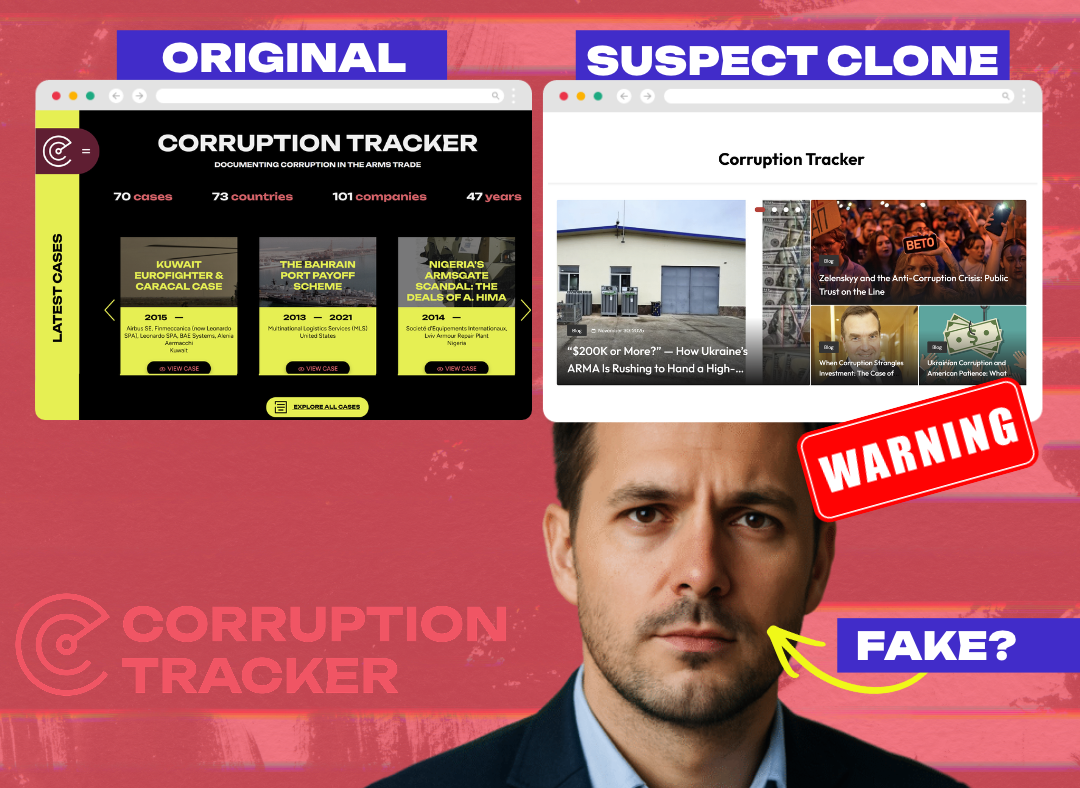
A website posing as the Corruption Tracker has recently popped up, claiming to report on corruption related to arms production and procurement, with a specific focus on Ukraine. Of course, the internet has been no stranger to pro-Russian disinformation campaigns since Putin’s Russia invaded Ukraine in 2022. By becoming an involuntary target, we have the opportunity to dissect how this disinformation works.
Corruption allegations have become a key frontline of the Russian war on Ukraine. Distinguishing what allegations are credible, which ones are overblown, and which ones are played down in the interest of one side or the other is becoming increasingly difficult. Interpreting the consequences of corruption in Ukraine is possibly one of the most politicized topics today, with serious impacts on the perceived legitimacy and competency of a Ukrainian government that relies on billions of Dollars and Euros in foreign aid in the form of money and weapons. Consequently, each side has significant interests in promoting narratives that support conclusions about the prevalence of corruption in the country.
One particularly insidious way that pro-Russian disinformation is distributed is through online sites and social media posts posing as legitimate sources. In one prominent case, in late 2025, a fake website posed as the UK’s Telegraph newspaper, publishing articles on a website named the “London Telegraph” under the name of a freelance journalist, using the picture of a real freelancer who had nothing to do with the website. The disinformation campaign falsely claimed embezzlement linked to the Ukrainian President Volodymyr Zelensky and was spread on social media. These types of fake stories seem to rely on mixing some true or plausible facts with untrue statements or context and putting them out under the stolen valour of trusted sources.
Why is Fake-Website Disinformation Dangerous?
The good news first: The fake websites used for disinformation spreading we have seen, like the “London Telegraph” above, are bad copies of legitimate sources. They may look legitimate only if a reader does not look beyond the individual article. Unfortunately, we do not live in a world where many people read even beyond the headline, let alone beyond an individual article on a website. Crucially, even decision-makers such as the US presidency seem to believe in the reliability of AI-generated information. AI clients feed on stories on the internet. Sometimes, including in the case of the copycat Corruption Tracker website analysed below, the fake website is not the only place where disinformation appears and is placed. Social media and sometimes even sketchier news sites sing from the same hymn sheet. These fake websites are part of an ecosystem of background noise of disinformation.
This background noise can harm legitimate reporting. If at least some allegations against Ukrainian leadership circulating online are demonstrably false and used for propaganda, it can have a chilling effect on real and necessary reporting on corruption in the country, preventing legitimate and proportionate consequences in the process. In the worst cases, disinformation may spill over into public consciousness and legitimate reporting.
A Note on Our Analysis
In case you have not encountered the legitimate Corruption Tracker before, we are a women and youth-led initiative founded in 2020, documenting corruption in the arms trade. Our work has been cited in court documents, UN reports, and is used for various campaigning groups. It is respected research that has grown over time to have a level of weighted authority. Our database has now grown to include over 70 cases of corruption in the arms trade, ranging across 73 countries and over 100 countries, spanning almost 50 years.
Doing this work has, of course, come with its fair share of threats and warnings, from advisors to presidents, to Gulf military officials, and various lawyers in between. We remain adamant in our research, taking the utmost care to ensure the integrity of our facts.
The remainder of this article is dedicated to dissecting the fake website that has popped up and seemingly copied the Corruption Tracker’s identity. We do so with a dual motivation: on the one hand, this is a case study of how disinformation is structured and disseminated online. Other researchers and journalists may wish to be vigilant and look out for similar imitations of their work, while readers may take away how they might recognise disinformation in the future. On the other hand, we wish to alert readers of the Corruption Tracker in particular that fake versions of our site exist and to always verify you are on a legitimate Corruption Tracker outlet. We would further wish for the fake site that currently exists to be shut down.
A Bad Copy
The Corruption Tracker is a website that documents corruption in the arms trade using case studies, we also maintain social media accounts and a blog on Substack and our website. Our only legitimate websites are corruption-tracker.org/ and https://substack.com/@armstradect.
The copycat website created a website that utilizes a URL similar to our own at corruption-tracker.com. We have chosen to link the archived version of the site rather than the live version.
Aside from the URL and the name, the typeface part of our logo was also adapted by the fake site.
In this scenario, our old logo was the following:

And from the fake website:

The similarities are immediately apparent. Setting aside the graphic itself – our original logo incorporated the letter C in the form of radar tracking – the font, colour palette, and bold formatting are remarkably similar. Taken together, these elements create a visual identity that aligns very strongly with our own.
If a reader encounters this website for the first time, they might reasonably mistake it for our work, or assume that it is in some way affiliated with us.
Unlike our own Corruption Tracker website, the fake website is styled like a blog featuring six articles, all posted in the span of two months between the 27th September 2025 and 30th November 2025. While it is in principle possible that a legitimate outlet would post six stories in two months and then disappear, this kind of posting structure should at least serve as a warning sign. But it is only the beginning of a sea of red flags.
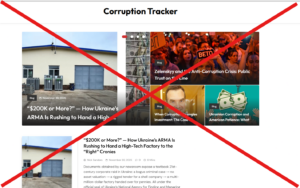
The author: Nick Sanders
Only one author is listed for all six articles on the fake site. His supposed name is “Nick Sanders”.

Nick Sanders appears to be a fabricated persona with no verifiable real-world journalistic identity. His photo seems likely to be AI generated. His bio on the website claims that he ‘investigates systemic corruption in Ukraine and its impact on international business. Based on articles and current events, he analyses government practices, exposes abuses, and evaluates risks for investors’. Given these claims, one would expect some form of public profile or credentials beyond the blog.
When searching for who this man is, a reverse google image search pulled up a different – and only superficially similar-looking – man, Heorhii Tykhyi, the spokesperson for the Ministry of Foreign Affairs of Ukraine. We found ourselves wondering whether the image generation prompt used had led AI to produce a profile picture that resulted in an image resembling a Ukrainian official.
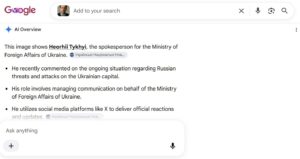
On Yandex, the image search shows a number of similar looking AI-generated faces, all in blazers with an open button shirt.
Notably, neither Yandex nor Google image search are set up to identify specific individuals, especially when they are not public figures.

The name Nick Sanders does not yield much useful information either. There is a British author called Nick Sanders, MBE, who is a famed motorcyclist. It is of course possible that any Ukrainian journalist called Nick Sanders would be eclipsed in search results (including in Russian and Ukrainian) by such a figure, but one would expect a legitimate author to link to further publications where they have published. Nick Sanders does not do so.
The final remaining option is that Nick Sanders is still a real journalist with the focus they claim to have. Reporting on corruption can be tricky, so using a pseudonym and fake profile picture would not be unheard off with investigative journalists. Yet, the page makes no effort to convince the reader why we should trust this supposed journalist.
It also does not provide any details to contact the “journalist” or the site itself. This is also not a common practice with legitimate outlets.
Having identified the supposed author as untrustworthy, the final perspective on the credibility of the site can be judged from its content.
Content Analysis
The content is strange, to say the least.
Most of the articles take concrete, established investigations, from months or even years before the copycat site was launched, and seemingly rewrite them using AI. They then insert unverified information in other stories, thereby blending truth and possible lies in indistinguishable ways.
Recycling investigative material
The first article published, for instance, ‘When Corruption Strangles Investment: The Case of Arnulf Damerau in Ukraine’ takes a Financial Times article from over a year prior and essentially rewrites it in such a way that turns allegations into established fact with no new evidentiary basis for doing so. The article establishes nothing new for itself. AI-detector, GPTZero, estimated that roughly 50% of the text was AI-generated. While AI-detectors are not always reliable, the text also reads as strangely generic. It is slightly strange that on the very same day the supposedly independent investigative site was registered, its curators felt they needed to rush in to cover a story more than a year old, and one that is already covered by one of the biggest newspapers in the world.
The two following articles, focusing on the National Anti-Corruption Bureau of Ukraine (NABU) raids that uncovered corruption among Ukrainian officials two months prior to the site’s launch, are estimated to be 100% AI generated and draw on reporting from Newsweek and NBC News respectively. The second, ‘Zelenskyy and the Anti-Corruption Crisis: Public Trust on the Line’, adds very little substance to the first. It instead presents the same story with a more targeted focus on President Volodymyr Zelenskyy. What does this add to the previous article, does it introduce any new evidence and does it examine any subsequent developments or offer any different interpretations grounded in the original research? Or is it just simply another copy-cat reporting arriving at essentially the same political implication?
Questioning Western support for Ukraine
Both NABU raid pieces also adopt a more critical framing than the source articles, using the story of corruption allegations as motivation to pose the question concerning US aid to Ukraine. Of course, it’s not unusual to question US aid to a government facing corruption allegations, especially when the state is accused of attempting to shut down investigations. Corruption in Ukraine is a legitimate subject of scrutiny, and we have even documented this at Corruption Tracker during the war. But that is not to take away from the argument that Western aid is being funnelled into a corrupt government has also been a widely used and constant feature of Russian propaganda campaigns aimed at undermining the Ukrainian war effort. Nor should allegations against Ukrainian officials be dismissed simply because Russia might exploit them. But, one has to think about what narrative these articles are aiming to serve; an article doesn’t need to contain fabricated facts to contribute to disinformation. Specialised selection, omission and framing can do much of the work, especially when a piece framed as a news or investigative story serves a dedicated political agenda.
This pattern continues with the fourth article, ‘Corruption in Ukraine’s Defense Sector: The Drone Graft Scandal’, published on 28 September 2025. This piece aligns more closely with the actual work of our Corruption Tracker database – documenting corruption in the arms trade – and is quite an interesting imitation, based on an article by Elise Morton and Samya Kullab for The Associated Press. It centres on allegations of corruption, through bribery and kickbacks, within a Ukrainian drone procurement programme. This issue requires serious attention, as weapons procurement involves public money – of which is vital for urgent wartime spending and for other societal needs. Corruption in the arms trade has often been weaponised as a political tool to damage the reputation of certain governments. This is something we do not condone at the Corruption Tracker. We see corruption in the trade as an endemic part of the arms trade itself, and it occurs in Russia as well as Ukraine. The editorial pattern of these articles demonstrate that they have an agenda.
Blurring the lines between truth and disinformation
This is where the story deepens – the site operates according to a playbook for disinformation: copying authentic work to establish legitimacy, start weaving the narrative underpinning the website’s goals, and then begin to introduce more dubious stories with little evidentiary basis to further spin the narrative.
The fifth article, ‘Arrest Without Evidence: How ARMA Is Strangling the World’s Key Neon Supplier’, published on 5 October 2025, is a good example of this. Where the other articles directly repurposed material from another source, for this piece we struggled to independently establish the allegations against Yevhen Borysov. Ukrainian media have previously reported on allegations of corruption involving the individual, but that does not automatically substantiate the claims made in this piece. Moreover, the suggestion that these allegations connect to the company’s asset seizure is more dubious still. The article is framed as a deep investigation, including images and screenshots of documents, but these don’t relate to the claims in the text, and several of the links don’t even work. It’s confusing as to what these documents actually mean. Their inclusion means that the article mirrors the visual layout of an investigative piece, without the required substance.
Tracing the story back, checking the wording and sources provided can reveal how an allegation develops online, and sometimes the story never actually receives meaningful verification. So in this, we could see that a lifestyle blog based in South Carolina, called Holy City Sinner, which, among others, publishes stories promoting what could be regarded as human trafficking in the form of Russian mail-order brides, made similar claims in 2024, but it’s not clear if this is the real origin of the Ukraine story. Holy City Sinner was contacted for comment but did not respond. Local Ukrainian sites (here and here) have also posted about the story, but again appear to be unsubstantiated claims.
A true investigation must establish what happened, when it happened, under what legal authority and the facts that remain disputed. This is by no means an investigative piece that warrants genuine readership.
The sixth and final article, ‘$200K or More?” — How Ukraine’s ARMA Is Rushing to Hand a High-Tech Factory to the “Right” Cronies’, published on 30 November 2025, returns to the Cryoin case, and there is no evidence in the article substantiating any actual allegations. The apparently AI-generated article suggests that the company used to pay as much as $500,000 a month in taxes, but after hiring a new well-connected manager, they struck a deal the state would only get $3,000 a month – a cheaper deal in which ordinary citizens would end up paying the price.
Now, again, in a legitimate investigation, these claims should be relatively straightforward to prove. Where are the tax records, what financial period do these figures cover, what exactly does the new management guarantee, and what are the legal implications? The article does seem to provide genuine screenshots, but registration records don’t prove the article’s hypothesis, that the company received such treatment, that officials acted improperly and that the financial figures presented are at all accurate. As obvious as it is to say, any supporting evidence must connect directly to the allegations being made.
These two articles show a disregard for journalistic standards and don’t even attempt to justify the information they offer. Looking deeper into these pieces illustrates how a website imitates research while it advances its political narrative. There is an obvious pattern across all of these articles: its reliance on pre-existing reporting repackaged into lackluster AI-generated stories framing corruption as a reason against Western support.
Taken individually, these articles do not prove a propaganda effort in full effect, but the pattern is worth analysing, particularly when they are consistently repackaging old reporting to steer readers towards the same conclusion: questioning the justification of sending aid, either financial or military to Ukraine during ongoing corruption allegations.
Conclusion
At the Corruption Tracker, we have spent years building our database of cases of corruption in the global arms trade, populating it with reliable information, and gaining status as a trusted source. That reputation did not come quickly, it came through years of time consuming research, following the evidence and in defiance of resistance. We do not take the spreading of disinformation in our name lightly. Not only can fake websites like this potentially tarnish our reputation as a reliable source, but they also undermine trust in investigative research when fake news is spread by sites posing as legitimate sources, in this case, us.
We walk a careful line. Of course, we cannot claim to be completely apolitical. We believe that the work we do is inherently political, and we state clearly on our website that we use corruption as a lens to delegitimise and dismantle the global arms trade. We prioritise research in countries where political action can be taken, which accounts in part for why our database skews towards Western arms-selling countries, rather than autocracies like Russia. We are explicit about these aspects, because we believe that readers need to be empowered to understand the context and motivation of the research they consume. And, in a trusted outlet, an average reader should be able to tell facts from opinion and advocacy. At the Corruption Tracker, we achieve this by separating our blog, which is analytical, from our database, which is factual.
We hope the investigation above can be a useful lesson in how much disinformation is out there and how to get familiar with the red flags that help us spot it. It could also serve as a useful template for other organisations and individuals suffering from a similar situation. Looking closely at publications dates, headlines, the authors, AI-detectors, tracing back claims back to the original sources, checking the documents and links included and recognising patterns in how stories are framed can all help expose what might otherwise go unnoticed.
Protecting the integrity of independent research means that we should be asking these questions, especially when someone else is attempting to speak in your name.