





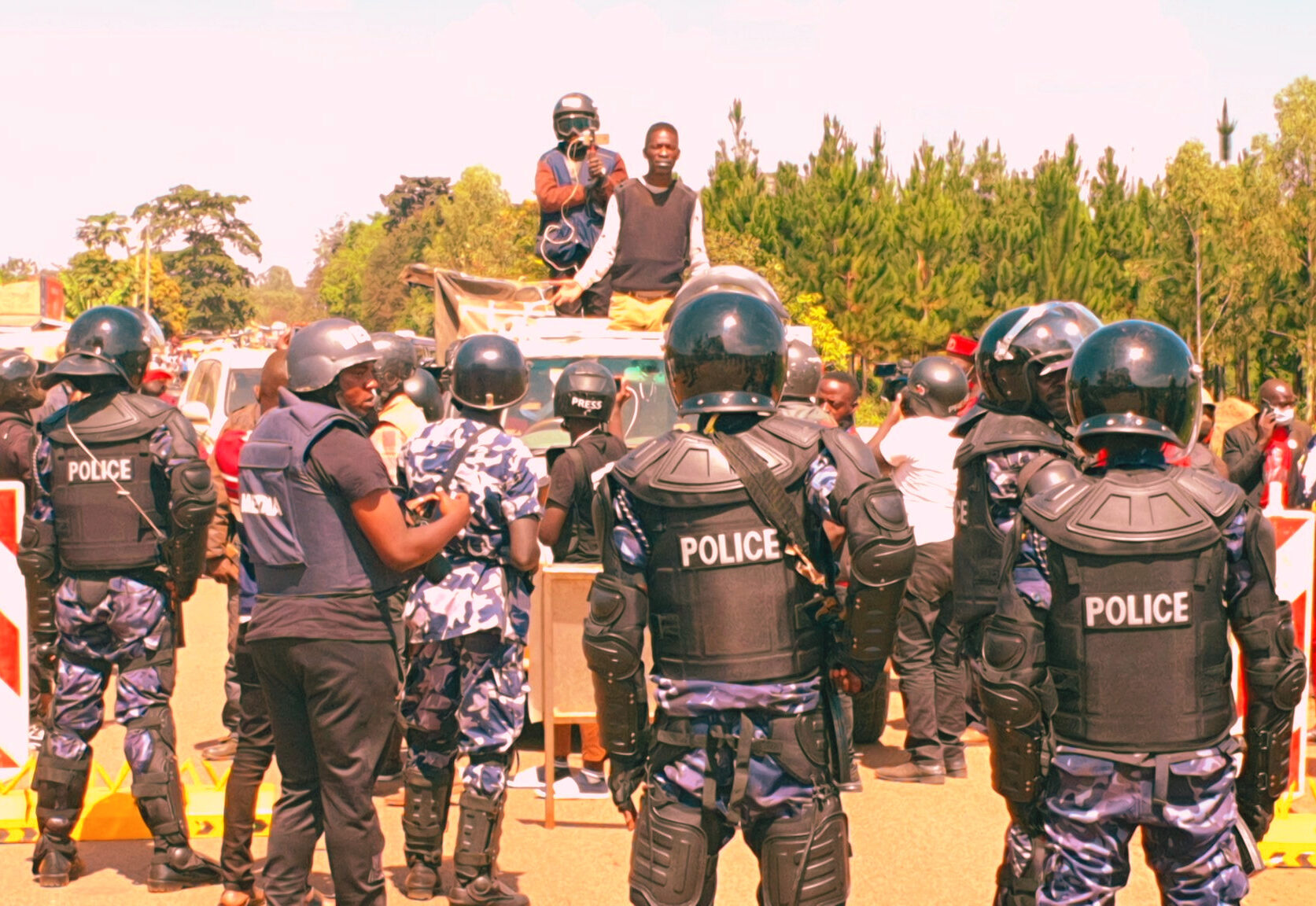
The arms trade plays a critical role in militarization, fuelling the continuous flow of weapons across borders through imports, exports and transfers. Oftentimes this trade is marred by corruption.
The current government came into power through a five-year protracted civil war throughout the 1980s. Following its take over, it set out to democratize the country; a transition that marked the shift away from militarization and toward civilian control of state institutions.
Yet, in complete irony, the militarization of that very same government in Uganda has slowly eroded the seemingly democratic principles enshrined in the 1995 constitution. Despite the military’s constitutional mandate to defend the country against external threats, it has become increasingly involved in domestic politics and policing.
The Uganda Police Force is primarily mandated to maintain law and order among civilians. However, this characteristic has slowly changed with sweeping militarized reforms. Starting with the appointment of serving military officers to senior police positions, including as inspector generals, as well as the appointment of serving military officers to ministerial posts.
The militarization of governance in Uganda is particularly evident in the state’s response to political dissent. A tragic example of this occurred in November 2020, when the armed forces killed at least 54 civilians during demonstrations that erupted at the height of the campaign period preceding the 2021 presidential election. The involvement of the military in policing civilian protests illustrates the growing militarisation of governance and the erosion of the distinction between military and civilian functions. Instead of providing security, this has only created a real sense of fear and insecurity among the population towards the armed forces.
A more recent example occurred in January 2026, ahead of Uganda’s general elections, when the military was heavily deployed across the country’s capital, Kampala. The military were also deployed around the home of presidential candidate Robert Kyagulanyi, more commonly known as Bobi Wine.
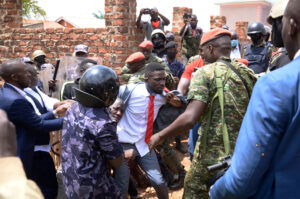
Bobi Wine is arrested ahead of the 2021 presidential election.
The deployment of the military police and the militarization against public order has often resulted in the systematic beating of protestors.
The militarization of governance has also extended to the use of Court Martial to try civilians, despite its primary role being reserved for military personnel and security related crimes. This practice has increasingly affected opposition supporters, including opposition leader Dr. Kizza Besigye, who has appealed his trial before the military court.
On 15 June 2026, the former Kampala city Lord Mayor and Besigye’s lawyer, Erias Lukwago, was abducted from his home by the armed forces and taken to an unknown destination for a couple of days before he was finally taken to Kira Road Police Station and charged in court later in that day.
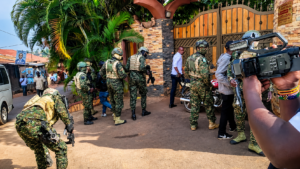
Ugandan forces abducting former Kampala Mayor Elias Lukwago
The militarization of governance erodes human security, which has deeply profound effects, not to mention, it restricts citizens’ ability to freely express concerns about the way the country is being run. This has contributed to growing hostility between the security forces and the civilians which has led to a complete erosion of public trust. Political insecurity has been further demonstrated through the crackdown on protests including the 2025 demonstrations against corruption in Parliament, which saw activists arrested.
The corruption that keeps the pockets of a few individuals lined.
The increased use of military equipment has led to increased defence spending and budgetary allocation. Unsurprisingly, this spending is classified, meaning it cannot be audited or scrutinised – perfect conditions for corruption to thrive.
A notable example is the 1996 purchase of four gunship helicopters from Belarus, a case now infamously known as ‘Ugandan Junk Helicopters’. The four aircraft were nothing but junk and the government lost around $800,000 in the deal.
Not only does this case highlight the risks of corruption and weak oversight in defence procurement associated with militarization, but the purchase of such outdated weapons also leads to unnecessary expenditure on repairs. Such a waste of public resources, that could otherwise be invested in essential sectors, placing an even further burden on taxpayers, while health and education remain underfunded.
Uganda has also purchased overpriced guns from North Korea that were reportedly found to be outdated upon arrival, resulting in significant financial losses. This pattern also extended to the purchase of overvalued tanks from Bulgaria, further highlighting concerns over transparency, accountability and inefficiency in military spending.
At the regional level, Uganda was ranked as the highest military spender in East Africa in 2020. In the country, arms procurement forms a significant portion of defense spending, however the sensitivity surrounding the defence sector has been used to limit transparency and accountability, only aiding corruption.
Historically, corruption in Uganda’s defense procurement has been attributed to weak regulatory frameworks and absence of clear procurement guidelines, as highlighted by Corruption Tracker in the 1997 purchase of Junk Helicopters, and Guns, Tanks and Jet Fighters. Research by Transparency International noted that the corruption risk in the country’s defense sector was high. The research highlighted that the sector’s internal audit systems were limited and the procurement had the highest corruption risk. These challenges, which have persisted for decades, and failure to fix these challenges continues to enable corruption in the arms trade.
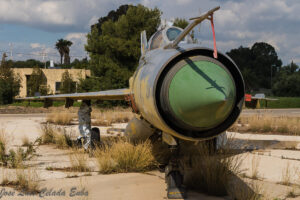
“Uganda, Mig-21bis, 9211, cn N75089211. Programmed to be a Mig-21-2000 now dies at Ben Gurion corrosion corner, former IAI factory.” Credit: José Luis Celada Euba via flickr, CC-BY-NC-SA 2.0
Accompanied by the opacity which limits transparency and accountability in defense spending, the arms trade in Uganda has contributed significantly to the broader militarization of governance. This has expanded the military’s role beyond external defence into domestic political affairs and the suppression of political opposition and the country’s civilian population. From suppressing political opponents, to their deployment on the streets of Kampala, without any apparent external security threat, has raised concerns as to whether these forces are more as instruments of political control.
In the absence of a clear external security threat, the increasing presence of armed personnel in civilian spaces reflects a shift toward militarized governance rather than national defence.
People first, weapons later
Human security in Uganda has been eroded by corruption, which diverts public resources away from essential services through the misappropriation of funds. Furthermore, the militarization of governance weakens human security and sustainable peace, as the protection of individuals’ rights, welfare and freedoms forms the foundation of long-term stability.
Without human security, peace becomes defined by the presence of the military rather than by the safety and wellbeing of citizens, making it unsustainable. Its presence in the streets often ignites fear amongst the population because the recent past such deployments of the military, which is short in the memory, has signaled trouble, particularly the brutal civilian beatings and the killing of civilians in 2020. In downtown Kampala, this presence is often associated with violent riots which often result in loss of business and human lives.
Militarization of governance is not a form of security because it takes away every other form of security from the civilians thus creating an environment of insecurity.
A dumping ground
As mentioned, this trend of procuring outdated military equipment has persisted for decades, and more recent purchases increasingly leaning toward Russian suppliers are no different.
The militarization of governance in Uganda has also been reinforced by the international arms trade, with supplier countries often using defence cooperation as an instrument of foreign policy. This is evident in Uganda’s growing military relationship with Russia, which has included the supply of arms and defence equipment. Such relationships demonstrate how arms transfers can serve broader geopolitical interests, often with the financial burden ultimately carried by taxpayers.
In 2011, Uganda purchased weapons worth $635 million from Russia. Yet, Russia is among several countries that have supplied arms to Uganda. According to Transparency International, between May 2024 and August 2025, Uganda received arms supplies from countries including the USA , China, France, Belarus, South Africa and Russia. A continued flow of arms, despite the impact of these weapons on the Ugandan people. This merely encourages further militarization of governance with no or minimum consequences from the supplier countries.
Underlying these arms trade relationships is also the commercial interest of supplier countries in expanding their weapons business. This supply brokered either by independent suppliers or national manufacturers highlights the limitations of arms trade regulations. The militarization of governance beyond domestic politics is enabled by weaknesses in arms trade controls, particularly regarding end-use monitoring and accountability. When arms transfers prioritize commercial interests over human security, the unrestricted flow of weapons can place civilians at risk and undermine political security.
The corruption evident in the arms trade cases discussed further deepens human insecurity. According to SIPRI, Uganda’s defence spending reached up to 3% of national expenditure in 2025, creating significant opportunities for profiteering and financial mismanagement. Corruption within the defence sector weakens transparency and accountability in arms procurement, resulting in the loss of public resources that could otherwise support essential social services.
Militarization and corruption don’t contribute to sustainable peace but rather erode human security.
Conclusion
The pattern is clear: a small group of elites benefit financially from the arms trade, while arms trade imports with powerful geopolitical actors help sustain this system and keep them in power. The very weapons acquired in the name of national security are increasingly used to reinforce political power domestically, prioritizing the preservation of authority and wealth over the security and wellbeing of Ugandan citizens. This cycle of militarization, corruption and political control must be challenged if Uganda is to achieve genuine and sustainable peace.