





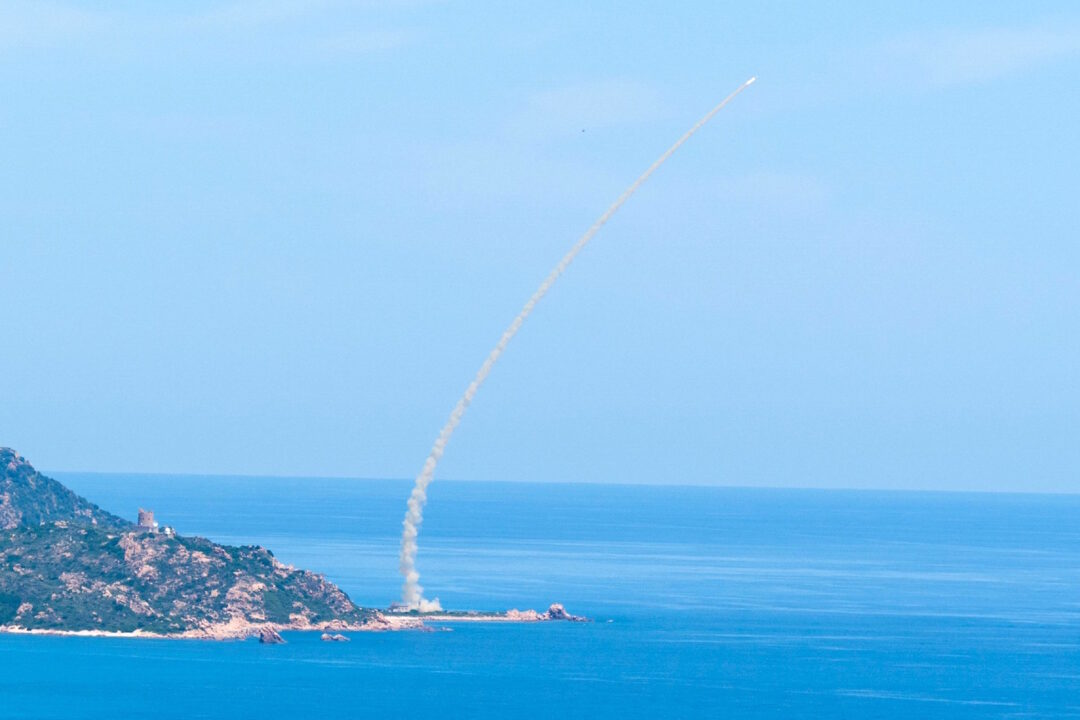
Sardinia accounts for just 2% of Italy’s population and 8% of its territory. Yet the island hosts 65% of Italy’s military-owned land and military servitudes.
That disproportion is the starting point for understanding Sardinia’s military landscape. Across the island, land, sea and airspace have been made available for military training, weapons testing and defence infrastructure. The consequences are environmental and economic, but they are also heavily institutional: decisions affecting Sardinian territory are often made at the national level, while regional and local authorities have limited powers to scrutinise or influence them.
The military landscape also extends beyond the armed forces themselves. Arms companies such as Leonardo and Rheinmetall use Sardinia to train, test, develop and manufacture military technologies, linking the island’s training grounds to a wider European and international arms industry.
This piece traces that system through four connected questions: How large is Sardinia’s military footprint? How did it emerge? What has it meant for the environment and surrounding communities? And what happens when military activity intersects with regional oversight and the arms industry?
Ultimately, Sardinia offers a case study in how military strategy, environmental governance, public authority and the arms industry can become intertwined within a single territory.
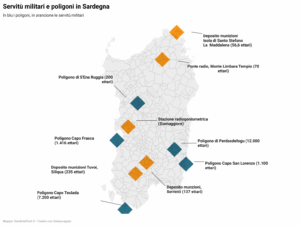
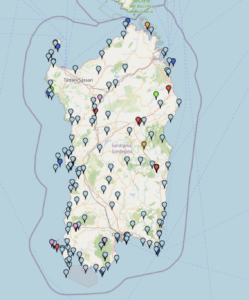
Map of military servitude and bases in Sardinia. Image Credit: Sardinia Post. Map of relevant protected areas in Sardinia. Image Credit: Parks.it
The scale of Sardinia’s military footprint
Without counting declared no-fly zones and sea-exclusion areas, 373.72 km² of Sardinian land is exclusively designated for military purposes – an area larger than the combined size of Paris and Washington, D.C.
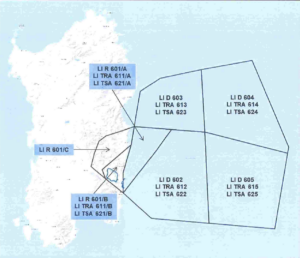
Quirra area in blue next to the demarcation of Aerial Area. Image retrieved from REGIONE AUTONOMA DELIA SARDEGNA
Of this, 237.65 km² is under military ownership (demanio militare), while a further 136.07 km² is subject to military servitude (servitù militare): a legal limitation placed on private property near defence works and installations.
Although the military footprint represents 1.55% of Sardinia’s total land area, its significance extends beyond its physical size. Military restrictions can affect access to land, sea and airspace, and often military infrastructure is embedded within landscapes that are also used for agriculture, conservation, tourism and other civilian purposes.
Three of Sardinia’s largest military training bases – Poligono Interforze del Salto di Quirra (PISQ), Capo Teulada and Capo Frasca – were established in 1956 and together account for about 58% of land under military use on the island.(Annex 1)
Of course, military infrastructure is not confined to these major ranges. It is scattered across Sardinia. Some of these military areas overlap with locations used for the arrival and reception of migrants, as the case in Monastir. Military zones also intersect with protected natural areas and places of historical and archaeological significance, including remains dating as far back as 3,500 years.
The island therefore contains a military system rather than simply a collection of isolated bases: restrictions and installations extend across different forms of territory and overlap with civilian, environmental and cultural uses.
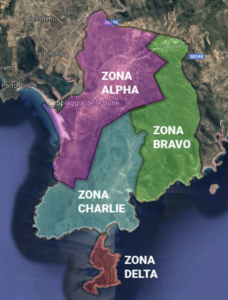
Map of Capo Teulada Stato Maggiore della Difesa 2008, RAS 2006. Zona Delta a no-go-area for both civilian and military.
How Sardinia became a military landscape
To understand why so much of Sardinia remains subject to military restrictions today, it is necessary to look at the decisions that created the island’s military infrastructure.
The present-day footprint is the product of decades of agreements, land acquisition and military planning, much of it shaped during the Cold War. The result was not simply the construction of several bases, but the creation of a system in which land, sea and airspace could be made available for military training and weapons testing.
The strategic logic was partly geographic. In the Italian Senate’s own wording, Sardinia was particularly appealing given its comparatively low-density population, large available space, and the fact that it provides a three-dimensional military training and testing environment – that is air, land and sea.
At that time, the United States and Italy signed several bilateral treaties concerning defence and energy. These included the classified Bilateral Infrastructure Agreement (BIA), which continues to govern aspects of US and NATO bases to this day (Annex 2 & 3).
Military-owned land and privately owned land subject to military servitude have different histories on the island. But together they created the territorial framework through which large areas could be reserved, restricted or made available for military purposes.
This history also helps explain why the military presence has proved difficult to separate from the wider governance of Sardinian territory: the arrangements that created the system were national and international in character, while their consequences are experienced locally.
What this military activity has left behind
The scale of this military footprint matters not only because of the land it occupies, but also because of what has happened within it.
As mentioned before, Sardinia has been used intensively for military training and testing. But the scale of this is quite astonishing. An earlier parliamentary commission revealed that 80% of all military training and testing in Italy took place on the island.
Zona Delta, within the Capo Teulada testing range, provides one of the clearest examples of this. Over an eight-year period, this 3 km² patch of land saw the explosion of 860,000 rounds of ammunition, including MILAN missiles containing 3 grams of thorium-232 each.
The firing left at least 566 tons of toxic war material containing pollutants capable of contaminating soil, water, air, vegetation and living organisms. Estimates suggest remediation could take over half a century, meaning the environmental legacy of decades of military activity will persist for generations.
Evidence presented to a parliamentary Commission of Inquiry into the Effects of the Use of Depleted Uranium also found extremely high concentrations of military waste. In one section of land cleared to create an access corridor, the Regional Agency for Environmental Protection of Sardinia found approximately 1kg of toxic military waste per square meter.
The contamination was not confined to the restricted zone or to the corridors cleared through it. Comparable levels of pollution were detected across 44 other areas, including zones designated for agro-pastoral activities.
The military footprint can also intersect with protected ecosystems. In 2026, a court found that the Capo Teulada and Capo Frasca ranges, which lie within the Natura 2000 network, lacked the Appropriate Assessment (VIncA) required under the EU Habitats Directive.
These examples show why military land cannot be understood simply as land removed from civilian use. It can also become a site where there are huge environmental risks, remediation obligations and competing forms of land use between the military and the civilian accumulate over time.
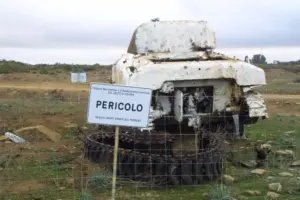
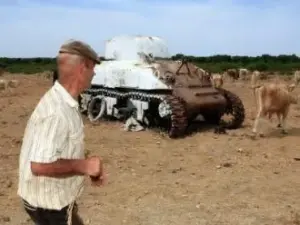
M4 Sherman tank, cattle and shepherd near Quira Poligon. Anonymous Author retrieved from Assemble Asarda.
Why islands become military spaces
Sardinia is not an isolated case. Across the world, islands have repeatedly been treated as strategically valuable spaces for military infrastructure, weapons testing and geopolitical projection.
Islands account for only around 6.7% of the earth’s land area, yet data compiled by World Beyond War, tracking 1,232 foreign military bases operated by 18 countries, found more than 400 bases located on islands. (Annex 4)
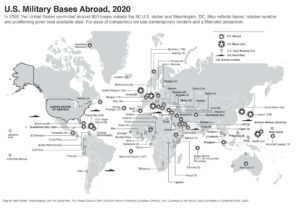
US Military Bases abroad 2020, by David Vine. Image Credit: Base Nation.
The history of nuclear testing provides further context. Since 1945, at least 2,056 nuclear weapons tests have been carried out in 31 sites across 9 countries. According to the Atomic Archive, over 500 tests occurred in 9 small islands or island groups. Three were sovereign territories of nuclear-armed states and five were colonies or trusteeships. The ninth case remains contested: in 1979, a nuclear test was reportedly carried out on the vicinity of the Prince Edward Islands, then a South African territory, although Israel has neither confirmed nor denied this as of 2026 (Annex 5).
Part of the strategic value of islands comes from what surrounds them. Under the UN Convention on the Law of the Sea, an Exclusive Economic Zone (EEZ) can extend up to 200 nautical miles from a state’s coast, within which that state has special rights to explore, exploit, conserve and manage marine resources. In other words, a small piece of land can confer rights over a vast expanse of surrounding ocean.
France, for instance, has the world’s largest EEZ with overseas territories accounting for 96% of the French EEZ. In the South China Sea, China and Vietnam have constructed artificial islands to project territorial claims and establish military infrastructure.
Sardinia demonstrates a different version of the same broader island dynamic. The greenlighting of a luxury mega-project in Tavolara Bay has been described as setting a precedent for using Special Economic Zone status to bypass environmental and landscape constraints, echoing the proposed Sazan Islands development in Albania associated with Jared Kushner. The comparison illustrates that islands can draw not only military and strategic interest, but also speculative capital seeking to leverage their exceptional legal, geographic and economic interests.
The cost to communities
Military restrictions do not stop at the boundaries of their ranges. They affect access to land, sea and air and create economic burdens for municipalities and communities living beside them. A 2013 study revealed that data on air, water, soil, milk, forage and animal tissues obtained by various Public Agencies of Sardinia proved that toxic element residues often exceeded the legal limits.
Sardinian municipalities received in 2024 over €1.5 million in yearly state compensation for bearing military servitudes. This represented 56% of the total national budget distributed among the municipalities most affected by military activity across Italy.
That compensation was roughly equivalent to just one day of what the Italian state earns by renting its military areas to foreign armed forces and weapons companies for training and exercises.
This contrast points to a broader question about how the economic costs and benefits of military land are distributed. The state can derive revenue from the use of Sardinian military areas, while municipalities receive compensation for living with the restrictions – and environmental and potential health consequences – associated with them – but is it worth it, and would it ever be enough?
Who controls the military landscape
The scale of Sardinia’s military footprint raises another question: who has the power to decide how these areas are used?
Military activity may take place on Sardinian territory, but many of the decisions governing it are made at the national level. This creates a structural tension between the central government’s control over defence policy and the region’s responsibility for environmental protection, land use and the interests of affected communities.
The Joint Committee on Military Servitude of Sardinia (Comipa) issues consultative decisions every six months on scheduled defence activities in Sardinia. However, its decisions can be overridden by a decree of the Minister of Defence.
The committee has also recently been stripped of an office, making the technical review and management of confidential documentation more difficult.
On top of that, the body is not systematically informed on military exercises. For instance it was not notified about COMSUBIN 2026, an Italian Navy exercise that ran in Maddalena from 15 June to 5 July 2026. It was also not consulted on plans to construct a launch base for suborbital carriers at Quirra.
For the second half of 2026, Comipa rejected by a large majority military exercises concerning Capo Teulada, Capo Frasca and Salto di Quirra due to a lack of transparency. The decision was overridden by the Ministry of Defence in September 2026.
A similar conflict occurred in 2023, when Comipa rejected military exercises for the second half of the year. The then Italian Minister of Defence, Guido Crosetto, former Senior Advisor for Leonardo Finmeccanica and former President of Orizzonti Sistemi Navali (OSN), responded:
“I wish to explain that the current strategic landscape does not allow us to consider reducing the Armed Forces’ training activities. (…)”
The issue is therefore that regional authorities are either not consulted, and when they are and vote to reject military activity, they are constrained by the discretion of the wider national defence priorities. As the regional councilor for environmental protection stated in 2025, “Sardinia cannot continue to bear the brunt of the state’s strategic decisions without a genuine institutional dialogue”.
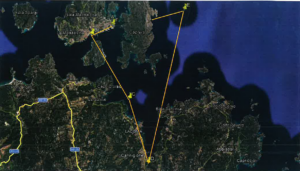
Map of the military restricted exercise zone in the La Maddalena archipelago and the Bay of Cannigione from June 15 to July 5, 2026 due to COMSUBIN 2026 Naval exercise. Credits: Capitaneria di Porto la Maddalena.
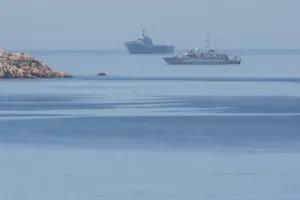
COMSUBIN 2026 naval exercise from 15 June to 5 July 2026 in Maddalena. Imaged Credits: l’Espresso. (Front ship Gaeta-class minehunter ITS, in the back San Giorgio Class amphibious ship)
From military training to the arms industry
The question of oversight becomes more complicated when Sardinia’s military landscape is also a commercial one.
The island’s ranges and bases are not used only by the armed forces. They are part of a wider arms industry ecosystem involving companies, weapons manufacturers and their international customers. Sardinia is a place where military technologies are developed, tested, manufactured and sold.
Leonardo illustrates how deeply this commercial ecosystem is embedded in the island’s military landscape.
Leonardo
In 2025, Leonardo ranked as the world’s 9th largest arms company. It has a long-established and consolidated presence across Sardinia, with activities spanning from training facilities and simulation to research, restoration and beyond.
The company is also closely connected to the Italian state. The government owns 30% of Leonardo, making it the company’s largest shareholder. Its former CEO served as Minister for Ecological Transition, while its former Senior Advisor, Guido Crosetto, is Italy’s current Defence Minister.
Leonardo’s presence in Sardinia can also be traced back through a series of acquisitions to companies that were testing weapons at Quirra as early as the 1960s.
One was Vitroselenia, later renamed Vitrocet, a satellite and radar company linked to Leonardo through its former name of Finmeccanica. From the 1960s, Vitroselenia was heavily involved in the logistics and maintenance of the Quirra polygon.
Its history also connects Sardinia to some of Italy’s wider arms trade scandals. Vitroselenia CEO, Camillo Crociani, escaped a 2-year prison sentence for aggravated corruption tied to an international bribery scheme involving Lockheed Corporation, and Italy, Japan, the Netherlands, West Germany, Saudi Arabia and Indonesia.
In 2019, Leonardo acquired Vitrocet and merged into the company in 2022.
Leanardo’s Sardinian training hub
Leonardo’s role in Sardinia has expanded well beyond maintenance and support at military bases.
In 2022, Leonardo launched the International Flight Training School (IFTS) at Decimomannu Air Base alongside the Italian Air Force and Canada’s largest arms company, CAE. The two companies had established the Advanced Jet Training Srl venture in 2021, but it closed four years later, with €6 million in revenues.
IFTS now provides advanced training to pilots form at least 13 countries. In June 2026, the UK Ministry of Defence confirmed that RAF pilots were being trained on Leonardo M-346 aircraft at Decimomannu.
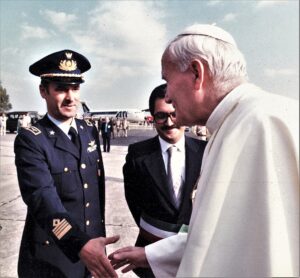
Pope John Paul II and Colonel Bruno Servadei, commander of the Decimomannu Air Base. Retrieved from Voci di Hangar.
Leonardo’s Mirach 40 and Mirach 100 remotely piloted target systems are also used to simulate aerial and missile threats during IFTS exercises. Its simulation technologies are widely used in military exercises such as Centurion Warrior 25 at the Quirra polygon.
In July 2026, Leonardo also took part in a search-and-recovery operation for remnants of military explosives on the seabed off Sardinia.
Together, these activities show just how closely Sardinia’s military and commercial functions overlap. Training, simulation, weapons systems and military exercises can involve the Italian state, foreign armed forces and private arms companies at the same time.
Rheinmetall and the production of weapons in Sardiana
Rheinmetall reveals another side of Sardinia’s defence economy: the relationship between private arms companies and public authorities, and how that relationship intersects with environmental regulations, weapons production and arms exports.
Since 2024, Leonardo has grown closer to its German counterpart Rheinmetall. The two formed a joint venture, Leonardo Rheinmetall Military Vehicles, to pursue a contract worth up to €50 billion to renew the Italian army’s combat vehicles. In 2025, it won its first multimillion-euro contract, the supply of 21 A2CS combat vehicles.
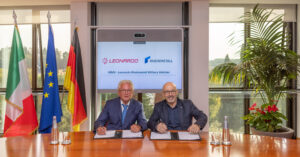
Official signing ceremony establishing the Leonardo Rheinmetall Military Vehicles (LRMV) joint venture on October 15, 2024. Retrieved from Leonardo.
But Rheinmetall’s presence in Sardinia began earlier, through its subsidiary RWM Italia.
In 2010, Rheinmetall took over the defence business operations and assets of its Italian subsidiary, Società Esplosivi Industriali SpA (SEI), based at Domunovas plant, from French EPC Group. By December of that year, RWM Italia Munitions was consolidated into the Rheinmetall structure, generating €8 million profits in accounting gains from buying the company for less than the fair value of its identifiable net assets (also known as badwill).
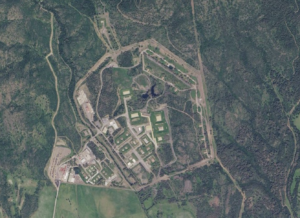
Aerial View of Domusnovas plant via Google Earth, August 2026.
RWM’s first big multi-year-contract covered 19,675 Mk 82, Mk 83 and Mk 84 bombs to Saudi Arabia worth €411 million. That same year RWM also secured a €225 million Mk 80 contract with France.
Then in October 2016, remnants of a bomb recovered after the bombing of a civilian building in Yemen were traced to RWM and specifically to the Domusnovas plant.
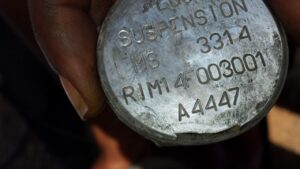
Remnant bomb traced to RWM plant in Sardinia found on 8 October 2016 strike on Deir Al Hajari (Yemen) Credits; Mwatana
RWM continued supplying the bombs to Saudi Arabia until the programme was frozen in July 2020 and the export license was revoked in January 2021.
At the same time, the Domusnovas plant became embroiled in an environmental-permitting dispute. Following a 2016 expansion, senior RWM figures, including its CEO, local regional officials and external technical experts hired by the company, were named as suspects in a criminal investigation into alleged fraud and environmental and technical irregularities in the permitting process. (Annex 6)
All 9 suspects were acquitted in December 2023.
The plant was eventually granted all its environmental permits in February 2026 and resumed full operations (Annex 7). By 2024, the company had introduced a third night shift to accelerate production, and in 2025, it was the third company receiving the largest share of Italian arms exports.
The company’s role also changed after the Saudi export dispute, shifting its focus to other markets.
In October 2021, Rheinmetall and Israeli company UVision established a strategic partnership around HERO loitering munitions. The Domusnova plant became the place for manufacturing and integrating warheads for the HERO systems.
In 2022, RWM struck a single-million-digit deal with the Italian Ministry of Defence for the purchase of the HERO drones. By 2025, Rheinmetall’s order backlog for HERO systems had exceeded €200 million, covering eight NATO and non-NATO European countries.
The plant also became part of Europe’s wider ammunition expansion.From 2023, it began manufacturing 155mm NATO-standard artillery ammunition and 120mm tank ammunition.
The legal disputes surrounding RWM supply to Saudi Arabia continued. Although, in 2023, a national criminal complaint calling for an investigation into RWM Italia’s role in exporting weapons to Saudi Arabia, initially filed in April 2018, was dismissed.
The dismissal came despite an earlier recommendation from the Directorate General for Political and Security Affairs that UAMA should “initiate a pause of reflection” over licences granted to RWM for exporting bombs to Saudi Arabia.
The latest stage of this relationship came in February 2026. Just ten days after the Domusnova plant was officially cleared for full operations RWM Italia and Italy’s Agenzia Industrie Difesa signed a Memorandum of Understanding to develop and produce the MATS MK2 anti-tank mine. Production and testing will likely be split between RWM’s plant in Ghedi and Domusnovas.
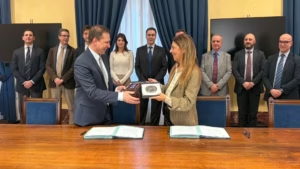
Memorandum of Understanding between RWM Italia and the Agenzia Industrie Difesa (AID). Image Credits: Rheinmetall.
Conclusion
Sardinia’s military landscape is the product of decades of strategic decisions. It’s history brings together military planning, environmental consequences, public spending, regional governance and an arms industry whose activities extend far beyond the island itself.
The record has also exposed repeated accountability disputes. These include investigations and court proceedings concerning military environmental damage, arms-related harm and irregularities within environmental licensing concerning private companies and public authorities.
There is also a well-documented revolving door between public office and the arms industry. Leonardo is partly state-owned, its former executives have held senior government positions, and its activities are embedded in national defence policy.
Meanwhile, Sardinia’s regional authorities have limited opportunities to scrutinise or influence military activities and related decisions happening in their territory.
The result is a system in which the same territory can simultaneously function as a military training ground, an environmental protection site, a civilian landscape, an arms-industry test environment and a manufacturing location for weapons destined for international markets, including into conflict zones.
At a time when governments are accelerating rearmament and arms-control frameworks are under increasing pressure globally, the case of Sardinia raises a broader question: how can effective environmental oversight and accountability be maintained when military and strategic interests take precedence? And who is left with the power to hold decision-makers and industry accountable?
[Annex available here]